
Southeastern Pennsylvania cycles above and below 32 degrees roughly 40 to 60 times in an average winter, and each swing moves water inside the soil under a patio. That repeated expansion is what lifts, tilts, and separates pavers, and it is almost always a base problem rather than a paver problem. A properly built hardscape patio in Doylestown by Rich’s Landscaping survives those cycles because the aggregate underneath drains faster than the freeze can take hold.
The engineering is not complicated, but it is unforgiving. Skip four inches of stone or one round of compaction, and the damage shows up in the second or third winter, long after the crew has left.
What Freeze-Thaw Actually Does to the Ground
Water expands about nine percent when it turns to ice. Trapped in fine clay and silt soils, that expansion pushes upward against whatever sits on top, which is the mechanism behind frost heave.
The worse problem is ice lensing. As the freezing front moves down through saturated soil, it pulls additional moisture upward by capillary action and stacks it into horizontal layers of ice that can lift a surface an inch or more.
When the thaw arrives, those lenses melt and leave voids. The patio settles back down, but never evenly, and every repetition widens the gap between the high spots and the low ones. Local soils made up of silt loam over weathered shale, which the USDA Web Soil Survey maps in detail for individual parcels, hold moisture long enough to make this a yearly event.
Why Poured Concrete Cracks Where Pavers Flex
A poured slab is a single rigid plate. When the soil beneath one corner lifts a half inch and the opposite corner does not, the slab has only one way to relieve that stress, and it cracks. Control joints direct where the crack appears, but they do not prevent it.
An interlocking paver system behaves differently because it is flexible by design. Thousands of individual units, locked together by joint sand and held at the perimeter by edge restraint, distribute load laterally across the field rather than resisting it as one piece.
The practical differences show up over a decade of winters:
- Movement tolerance: Pavers shift fractionally and settle back; a slab fractures permanently at roughly 0.25 inches of differential movement.
- Repairability: A sunken section of pavers can be lifted, the base corrected, and the same units reset in a day, usually for $400 to $1,200.
- Surface drainage: Open-graded joints let a small volume of water pass through rather than sheeting toward the house.
- Salt resistance: Manufactured concrete pavers are typically cured to 8,000 psi or higher, compared with 3,000 to 4,000 psi for a residential slab, so surface scaling from deicers is far less common.
None of that matters if the layer beneath the pavers is wrong. Flexibility only protects the surface when the base gives the water somewhere to go.
Base Depth Is the Variable That Decides Everything
For a residential patio in this climate, the working standard is 6 to 8 inches of compacted open-graded or dense-graded aggregate, usually 2A modified stone. Driveways and anything carrying vehicle weight move to 10 to 12 inches. Patios built over heavy clay, or over fill that was never properly compacted, often need 10 inches as well.
Crews cutting corners at 3 or 4 inches are the single most common cause of the heaving homeowners discover in year two. The stone layer is what replaces frost-susceptible soil with material that drains instead of holding water.
Excavation depth is therefore base depth plus bedding sand plus paver thickness. A patio using 2.375-inch pavers over 1 inch of bedding sand over 8 inches of stone requires an excavation of roughly 11.5 inches below finished grade, which is a meaningful amount of soil to haul off a typical lot.
Geotextile fabric placed between the subgrade and the stone adds another layer of protection. It stops fine soil particles from migrating up into the aggregate, which is how a base slowly loses its drainage capacity over 10 to 15 years.
Compaction in Lifts, Not All at Once
Aggregate dumped eight inches deep and run over once with a plate compactor is compacted on top and loose underneath. The industry practice, documented in the installation guidelines followed by Rich’s Landscaping and published by the Concrete Masonry and Hardscapes Association, is to place and compact in lifts of 3 to 4 inches.
Each lift gets multiple passes with a plate compactor, and larger jobs use a reversible plate or a roller. The target is roughly 95 percent standard Proctor density, which in field terms means the stone stops moving and the compactor begins to bounce.
Moisture content matters during compaction. Stone that is bone dry will not lock together, so crews commonly mist each lift lightly before the final passes. The subgrade itself also gets compacted before any stone goes down.
Polymeric Sand Keeps Water Out of the Joints
Joint sand does two jobs: it transfers load between adjacent pavers, and it blocks water from pouring straight down into the bedding layer. Standard masonry sand washes out of the joints within two or three seasons of rain and snowmelt, and once a joint is empty, the units lose their interlock.
Polymeric sand contains binders that activate with water and set into a firm, slightly flexible joint. The installation sequence is specific, and shortcuts here cause haze and failure:
- Sweep the sand into completely dry joints, filling to within an eighth of an inch of the paver chamfer.
- Compact the field with a plate compactor fitted with a protective pad so the sand settles fully into the joints.
- Top off any joints that dropped, then blow all residue off the paver faces with a leaf blower.
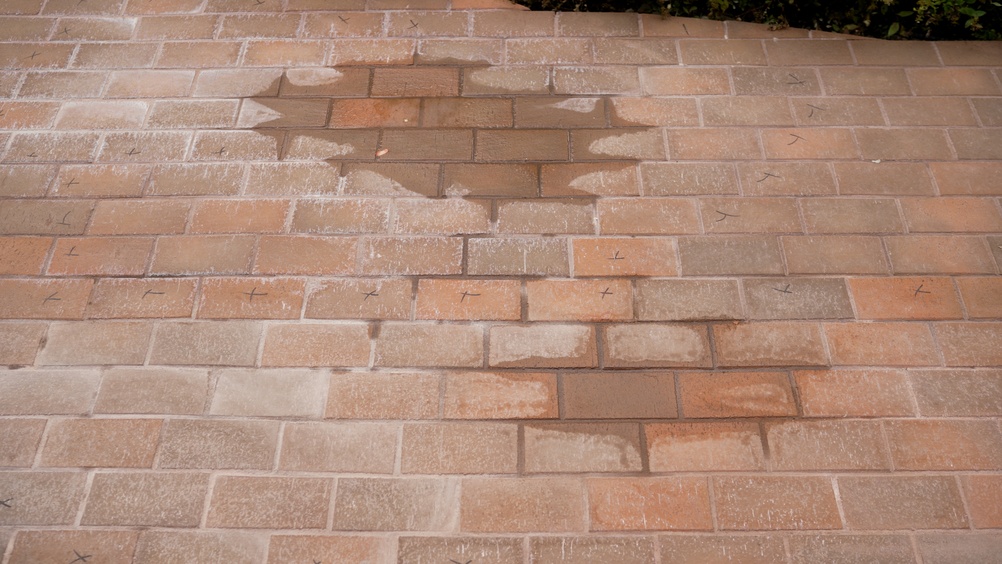
- Activate with a measured, gentle water application in stages rather than one heavy soak.
- Keep traffic off the surface for 24 hours and avoid installing within 24 hours of forecast rain.
Properly installed polymeric sand typically holds for 8 to 12 years before isolated joints need refreshing. It also suppresses weed germination and discourages ants from tunneling under the units, both of which create the small voids that frost later enlarges.
Drainage and Edge Restraint Finish the System
Surface slope is the cheapest frost protection available. A patio should fall 1/8 to 1/4 inch per linear foot, or about 1 to 2 percent, away from the foundation so meltwater leaves rather than pooling at the low end and refreezing.
Edge restraint spikes into the compacted base at 10- to 12-inch intervals hold the perimeter units in place. Without it, the outer course migrates outward a fraction each winter, the joints open, and the failure works its way inward.
Downspout discharge deserves attention too. A single downspout emptying beside a patio edge can saturate the subgrade under that corner all winter, which is why extensions or buried drain lines carrying water 10 feet or more past the hardscape are standard practice for Rich’s Landscaping. The same engineering governs a paver installation in Montgomery County and every walkway around it.
Early Warning Signs of a Failing Base
Heaving rarely announces itself all at once. Watch for a paver sitting a quarter inch proud of its neighbors in February, joints that have dropped below the chamfer line, or a puddle that lingers more than an hour after rain.
Catching those symptoms early usually means lifting a small section, adding and recompacting stone, and resetting the original pavers. Waiting three more winters often turns that into a full teardown of the affected area.
Frequently Asked Questions
How Deep Should the Base Be for a Paver Patio?
Six to eight inches of compacted aggregate is the working minimum for a pedestrian patio, and 10 to 12 inches for driveways or patios over clay-heavy subgrade. Depth is measured after compaction, not as the loose stone was delivered, which is roughly a 20 percent difference in volume.
Does a Paver Patio Need to Extend Below the Frost Line?
No. Frost depth is typically 36 inches for footings, but flexible paver systems are not required to reach it because they move slightly and return. Rigid structures attached to them, such as pillars, steps on footings, and retaining walls, do require frost-depth foundations.
Can Heaved Pavers Be Reset, or Does the Patio Need Replacing?
In most cases, a heaved area can be lifted and reset for $400 to $1,200, assuming the original base was adequate and the problem is localized. Patios built on three inches of stone or no stone at all generally need full reconstruction, because every section will fail eventually.
How Often Does Polymeric Sand Need Replacing?
Expect 8 to 12 years from a correctly applied installation, with isolated joints near downspouts or heavy traffic needing attention sooner. Resanding involves blowing out the failed joints, refilling, and reactivating, and typically runs $1.50 to $3.00 per square foot.
Are Pavers or Poured Concrete Better for Cold Winters?
Pavers perform better through freeze-thaw because the system flexes and individual units can be reset, while a cracked slab stays cracked. Concrete costs less upfront, roughly $8 to $15 per square foot compared with $18 to $35 for pavers, but repair costs over 20 years usually close that gap.
Talk Through Your Patio Base Plan With Rich’s Landscaping
Rich’s Landscaping builds every patio on an excavated, lift-compacted aggregate base sized to the soil conditions on the specific property. Contact Rich’s Landscaping to schedule a site visit and get a written scope that states base depth, drainage slope, and joint material before any work begins.